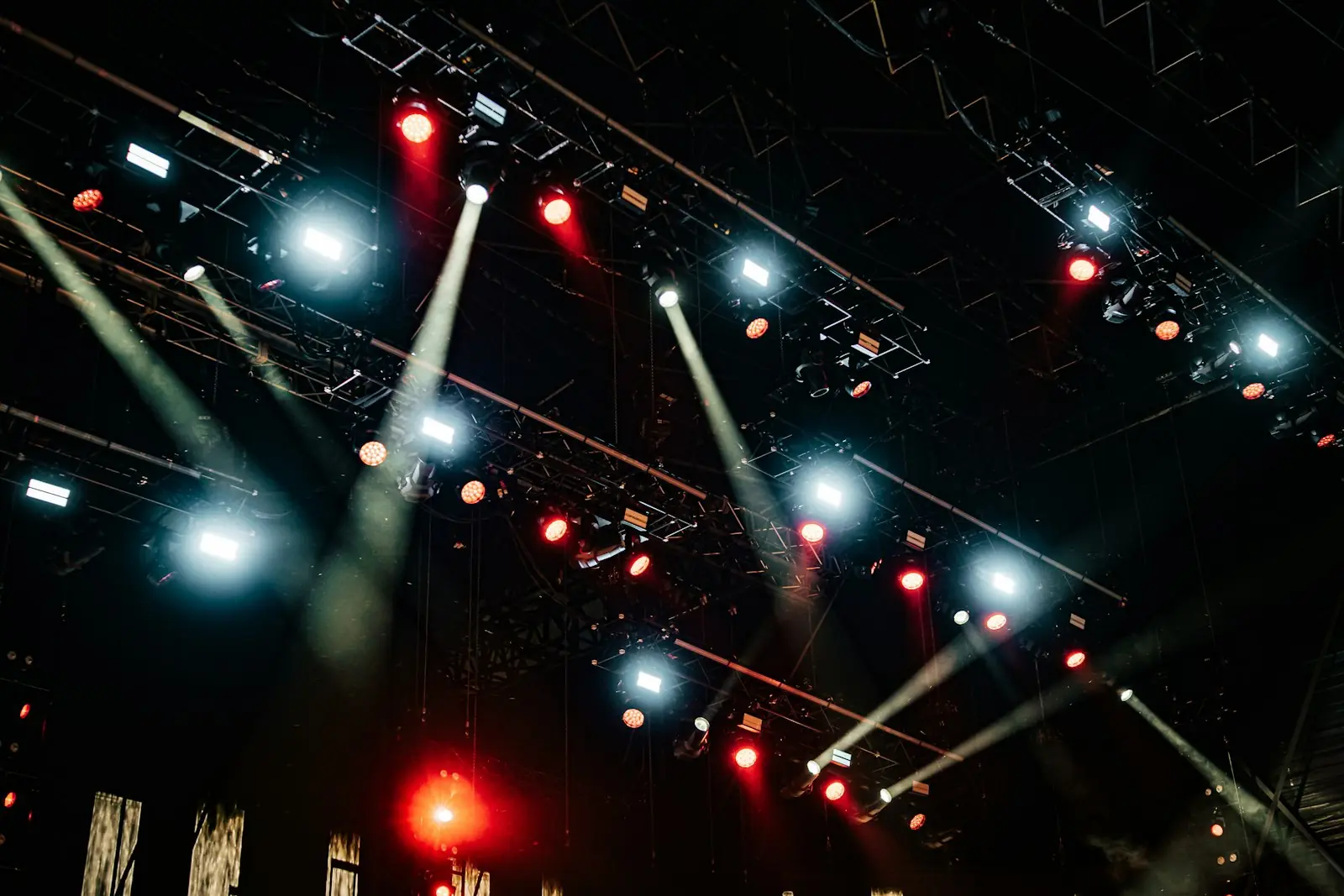
Concert stage, sound & lighting requirementsEvery line of the rider has to be true on the night.
Stage, roof, PA, LED, lighting and power for concerts in Bangalore, Goa and Kerala — scaled to the audience, drawn to the site, and checked against the artist’s technical rider before anything is loaded in.
What stage, sound, lighting and power does a concert need?
A concert needs a stage and roof sized for the band and its hung load, a PA that reaches the furthest listener (level falls about 6 dB per doubling of distance from one speaker), LED screens chosen by viewing distance (about 1 m per mm of pitch), a lighting rig, generators sized in kVA, and everything the artist’s rider lists.
The numbers here come from physics and manufacturer guidance, cited where they appear. The judgement comes from three inputs: a site drawing, the artist’s technical rider and a headcount. If any of them changes, the spec changes with it. Planning a show in Goa or Kerala? See festival production in Goa and concerts in Kochi.
Concerts rarely fail on the guitar solo. They fail on the parts the audience never sees.
- The back half cannot hear the vocals.Without delays, the far end of a field gets a fraction of the front’s level. We model coverage before we hire a box.
- The generator trips in the encore.A late extra LED wall pushes a set past its rating. We total every load from the spec sheets.
- The rider was read on the day.The band’s engineer expects the console and backline they asked for. We advance the rider weeks ahead and agree substitutions in writing.
- The stage edge is a drop.A raised deck without barricades is a fall waiting to happen. Every platform is drawn with its edges protected.
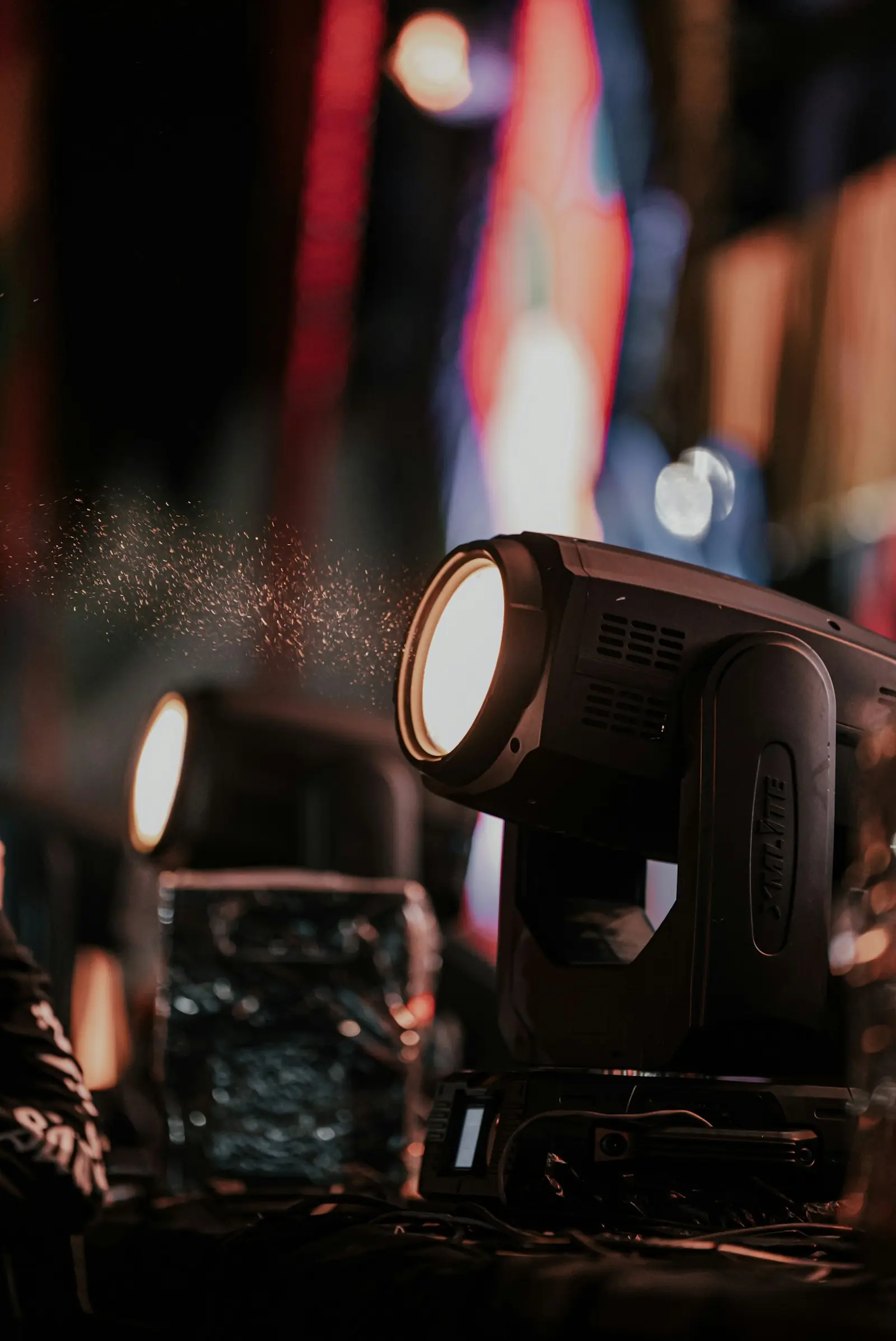
One technical plan, one person accountable
- Site drawing with stage, front-of-house position, delays, screens, generators and crowd lines
- Rider advanced line by line: supplied, alternative proposed, or not possible
- Sound coverage designed to the audience area and to the boundary noise limit
- Roof and truss loads counted against the manufacturer’s rating
- Power plan from spec-sheet loads, with separate feeds and backup
- Show caller on headset for every cue on the night
Concert stage setup by audience size
Four audience bands, and what changes between them. Use this to brief suppliers, then let the site drawing refine it.
| Audience | Stage and roof | Sound (PA) | Screens | Power |
|---|---|---|---|---|
| 300–800, ballroom | Riser stage; lights on ground-supported truss | Compact speakers or short arrays, front fills, band monitors | Centre or two side screens | Venue supply only if its engineer confirms the load |
| 1,000–3,000, convention hall | Larger riser; flown or ground-supported truss | Flown line arrays, subs, front and side fills | Centre LED plus side IMAG | Separate sets for sound and for light/LED, plus backup |
| 3,000–10,000, open-air | Roofed mobile stage (decks listed at 24 × 20 ft and 32 × 24 ft) or an engineered roof | Main arrays plus delay towers | Outdoor-rated LED and IMAG | Multiple sets, fenced distribution |
| 10,000+, festival field | Engineered roof, front-of-stage barrier | Main arrays plus rings of delays | Large outdoor LED, delay-position screens | Generator park with backup |
A planning starting point we use, not an industry rule: the sound designer’s prediction for your site and the artist’s technical rider decide the final spec. Mobile stage sizes from listings of the Stageline SL100 (SL100 listing) and SL260 (SL260 listing).
How the PA has to cover the audience
A single loudspeaker loses about 6 dB of level every time the distance doubles; an ideal line source loses about 3 dB, and real line arrays sit between the two depending on frequency (Pat Brown, SynAudCon). So a box producing 100 dB at 10 m gives roughly 94 dB at 20 m, 88 dB at 40 m and 82 dB at 80 m. That drop is why large audiences need line arrays and, beyond a point, delay towers.
| Distance from the main PA | Time for sound to arrive |
|---|---|
| 20 m | ≈58 ms |
| 40 m | ≈116 ms |
| 60 m | ≈175 ms |
| 100 m | ≈291 ms |
Times use sound’s speed of about 343 m/s in dry air at 20 °C, or about 2.91 ms per metre (speed of sound). A delay tower at that distance is set to match, so the nearer speaker never arrives first; the engineer fine-tunes on site.
The other limit is legal. Under the noise rules, loudspeaker noise at the boundary of a public place may not exceed 10 dB(A) above the zone’s ambient standard, or 75 dB(A), whichever is lower (a state notification restating the Noise Rules). Next to a residential zone by day, that works out to 65 dB(A) at the boundary (55 + 10). A good PA design puts the level on the audience and keeps it off the neighbours — aim and delays, not just volume. Noise rules for events, explained →
LED screens for a concert: size, pitch and position
Pixel pitch is chosen by the nearest viewer. A manufacturer rule of thumb is about one metre of minimum viewing distance per millimetre of pitch: a 1.5 mm wall reads cleanly from about 1.5 m (Christie). For a concert, where the nearest fans may be a few metres away and the furthest a long way back, the job splits in two:
- Centre or backdrop wall — content and atmosphere, pitch set by the front-row distance.
- Side IMAG screens — live camera close-ups for everyone too far back to see faces. Size them for the back of the room.
- Delay-position screens — for open-air fields, beside the delay towers.
- Outdoor rating — open-air shows need outdoor-rated panels; one listing prices outdoor walls at ₹8,000–15,000 per sq m per day against ₹5,000–8,000 indoors (Rajhans AV listing).
The lighting rig and what it depends on
Lighting is the line most often driven by the artist rather than the venue.
- Touring rig or house rig. Some acts travel with their own lighting design and console file; others send a lighting rider listing fixture types and counts for us to supply.
- Where it hangs. Indoors, from venue rigging points or ground-supported truss; outdoors, from the stage roof. Every kilo hung — lights, LED, PA — is counted against the roof’s rated load.
- Audience and safety lighting. Exit routes, the front-of-stage barrier and backstage stay lit throughout, whatever the show cue.
How to size generators for a concert
Start from the loads, not from the generator list. Five steps:
| Step | What you do | Example |
|---|---|---|
| 1. List the loads | Add the rated power of every lighting fixture, LED panel and processor, amplifier and backstage circuit from their spec sheets | Say the total is 120 kW |
| 2. Convert to kVA | Generators are rated in kVA at a 0.8 power factor, so kW ÷ 0.8 = kVA | 120 kW ÷ 0.8 = 150 kVA |
| 3. Add headroom | Never run a set flat out through a show; size up and plan for peaks | Choose a larger set, or split the load |
| 4. Separate feeds | Keep sound on its own set or feed, so lighting and LED cannot introduce noise or trip the PA | One set for sound, one for light and LED |
| 5. Add backup | A standby set, or a changeover plan, for the parts of the show that cannot stop | Backup for sound, show control and emergency lighting |
kW = kVA × power factor, with 0.8 lagging the standard generator rating (Toromont, generator power factor). Listed rental: about ₹10,000 a day for 125 kVA and ₹18,000 for 250 kVA, fuel usually extra (TransRentals listing). How much generator power an event needs →
What a concert technical rider contains — and how we answer it
An artist’s technical rider sets out what the act needs to perform: a stage plot, an input list, monitor requirements, preferred consoles, backline, lighting, power, crew and the load-in and soundcheck schedule. The hospitality rider covers travel, rooms, ground transport, the green room and catering. We return every technical line marked supplied, alternative proposed or not possible, agree it in writing with the artist’s team, and only then lock the budget. What a technical rider is →
Stage and site safety checks before doors open
- Stage and roof built to the manufacturer’s or engineer’s rating, with the hung load documented
- Edge barricades on raised platforms — a Kerala Fire and Rescue report on a 2024 Kochi stadium event cited barricades of at least 1.2 m on stages over two metres (South First, 30 Dec 2024)
- A front-of-stage barrier and pit for standing audiences, staffed throughout
- Generators, distribution boxes and breakers isolated from the crowd, fenced and guarded (NDMA crowd guide (2014))
- A wind and rain plan for open-air roofs, and a named person who can stop the show
Rules change; we confirm current requirements with the authority for your date.
How a Pani Productions event runs
Brief & ballpark
A 30-minute call with your event owner. You get a format, venue shortlist and an itemised cost range you can take upstairs.
Venue & concept
We check dates, layouts and rooms with venues, run a site recce, and build the creative: theme, stage, content flow.
Production plan
Stage, LED, sound and light specified and drawn. Delegate logistics, rooming lists, transfers and F&B locked to a master timeline.
Rehearsals
Technical rehearsal and a cue-to-cue run with presenters. Backup power, spare mics and playback files ready before doors open.
Show day
One show caller on headset runs every cue. Your team hosts; nobody from your side should have to carry a radio.
Close-out
Reconciled invoice against the estimate, vendor settlement, photos and a short debrief on what to repeat next year.
Questions people ask before they book
What size stage do I need for a concert?
How much sound do I need for 1,000 people?
When does a concert need delay towers?
What pixel pitch LED screen do we need for a concert?
What size generator do we need for a concert?
What is in a concert technical rider?
Tell us about the event
Rough is fine. Headcount, a city, a month. We come back with venue options, a format and a cost range you can take to your leadership — before you commit to anything.
- Itemised estimate: venue, food, production, logistics and our fee as separate lines
- Venue options checked for your date, headcount and layout
- GST invoicing for your finance team
Rather talk? +91 77669 40021 · WhatsApp · info@paniproductions.com
Keep planning
- How much it costs to organise a concert
- Sound and light rental in Bangalore
- Stage design and setup in Bangalore
- Music festival production in Goa
- Event production company in Bangalore
- Corporate event management in Bangalore
- Corporate offsites near Bangalore
- Corporate events and MICE in Goa
- Corporate events in Kerala
- What a corporate event costs in India
- Concert and festival production
- Corporate event questions, answered